
The Failure of Modern Solutions
For centuries, the Trondheim Post Road (Den Trondhjemske Postveg) braved the elemental forces of the West Norwegian fjord landscape, protected by a drainage system built beneath this historic path and developed over generations. In recent decades, however, it has been believed that this protection could be secured using modern means like plastic pipes and excavators. This turned out to be a mistake. Nature found a way around the plastic, threatening the historic trail.
The solution for the future therefore lies deep in the past. Right at the entrance to the Geirangerfjord, an extraordinary project is currently underway: experts are embarking on a journey through time to revive craftsmanship of the old times. Piece by piece, they are meticulously assembling a monumental puzzle to ensure the paths of our ancestors survive for centuries to come. Step by step, the plastic pipes are being replaced once again by traditional drainage systems made of dry stone walls.
Watch the masters at work: In the video, you can see just how fascinating this work is. It requires patience, strength and an intuitive understanding of nature. See for yourself how heavy individual components are transformed into a sturdy work of art that will last for generations.
The Art of the Dry Stone Wall
It sounds almost impossible: walls can withstand heavy loads and harsh weather for centuries – completely without cement, mortar, or modern binding agents. With the careful selection of stones, the craft of dry stone walling (tørrmuring) is used both underground for drainage systems and above the ground for retaining walls, terraces, field boundaries, livestock enclosures and pathways. Dry stone walling is one of humanity’s oldest and most sustainable crafts.
In the fjord region around Geiranger, this technique was vital for survival for centuries. The old craftsmen built roads, foundations, and drainage channels solely through the perfect arrangement of natural stones. The secret lies in balance, gravity, and the craftsman’s ability to look at a seemingly chaotic pile of boulders and spot the exact puzzle piece that will fit perfectly into the gap, interlocking the entire structure.
The genius of it is that a dry stone wall remains flexible enough to adapt to minimal movements of the ground, yet porous enough to allow water to flow through unobstructed – providing the ultimate protection against frost damage and erosion.
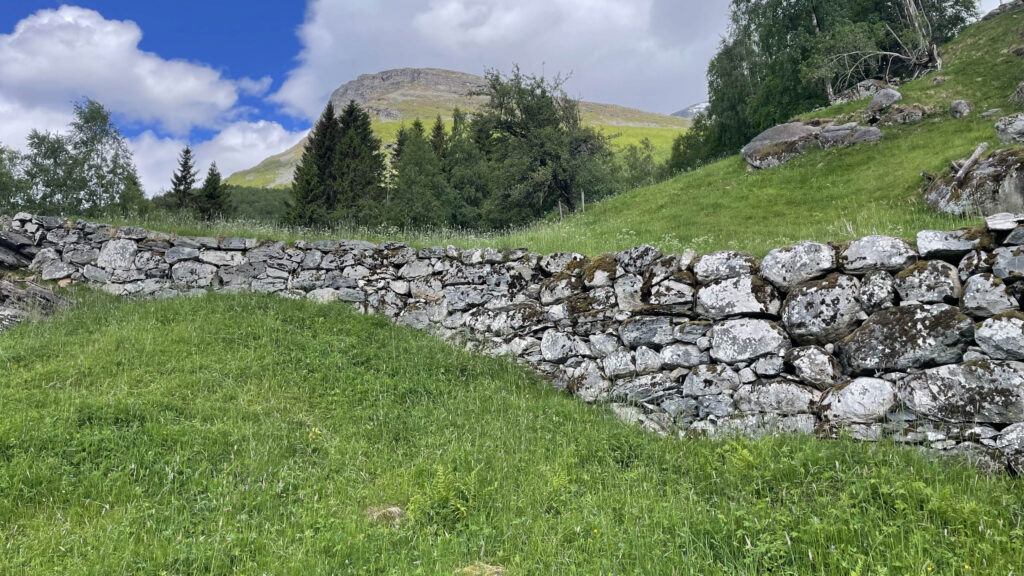
Dry stone walls for terracing close to the village of Geiranger. Foto: Aaron Hager
Written by Aaron Hager with the help of AI.